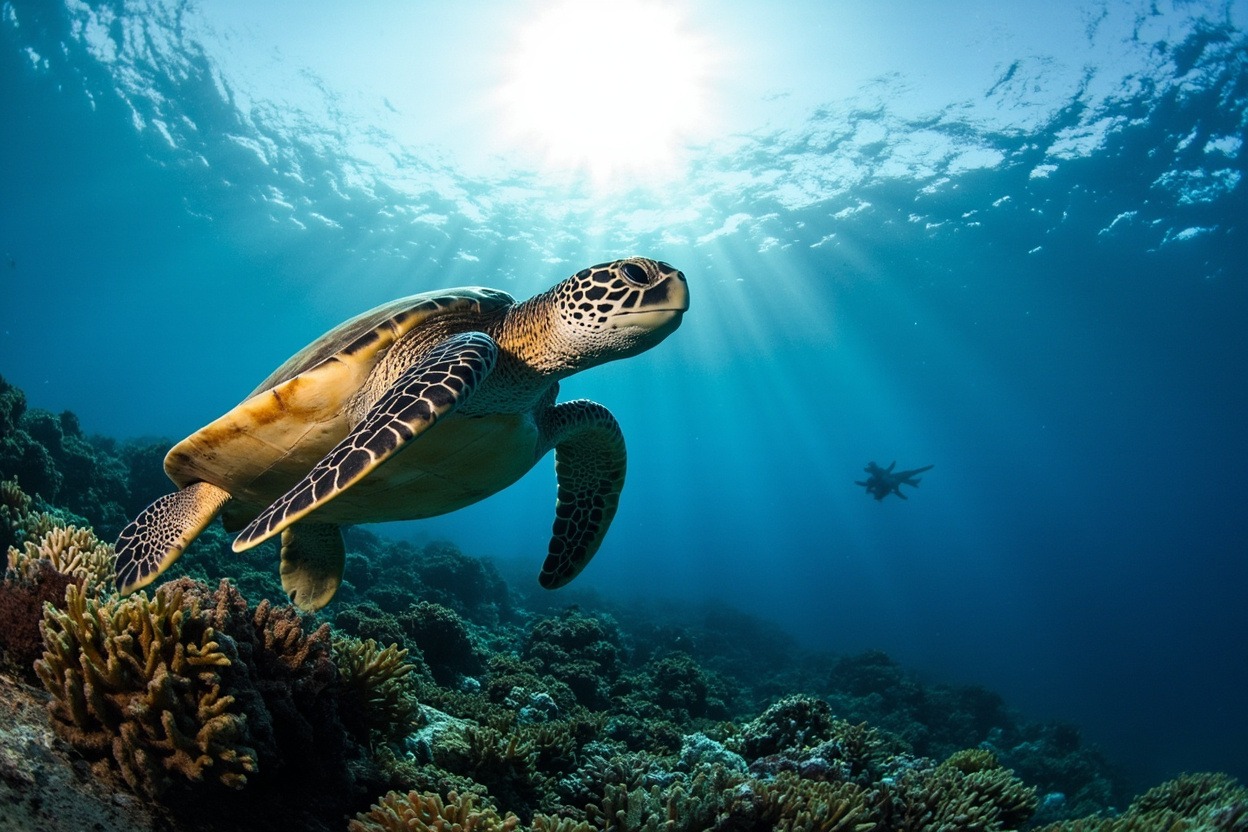
Loggerhead sea turtles, Caretta caretta, undertake long migrations between feeding areas, breeding areas and nesting coasts. They do not navigate with a single internal map. Research supports a combination of cues, including the Earth’s magnetic field, currents, wave direction and information available near coastlines.
Magnetic information
Young turtles can detect features of the Earth’s magnetic field and use them as part of an orientation system. This helps explain how they remain on broadly suitable routes across ocean basins. It does not prove that every turtle follows a fixed two-step programme or recognises human buildings from offshore.


Returning to nesting areas
Adult females often return to the general region where they hatched to nest, a pattern called natal homing. Nesting can occur across a stretch of coastline, not necessarily on the exact patch of sand where an individual emerged. Beach conditions, storms and disturbance can influence where a turtle nests in a given season.

Migration is species and population specific
Routes and timing differ among loggerhead populations. Ocean currents can carry hatchlings through offshore habitats, and older turtles may use different foraging areas. Exact nest totals, body masses and age estimates should be reported only with a named place, year and source.

Why navigation research matters
Protecting migration routes requires more than protecting a single beach. Bycatch, vessel strikes, light pollution, coastal development and climate-related changes can affect turtles at different life stages. The more accurately migration is described, the more useful conservation messaging becomes.

Different Cues Can Work Together
Magnetic information is not the only cue a turtle can use. Conditions near the surface, currents, waves and information close to shore may all contribute at different stages of a journey. This helps explain why a migration is not a perfectly fixed line on a map. A route can vary while still linking important feeding and nesting areas.
Protecting Nesting Beaches Helps at One Stage
Beach management can reduce disturbance to nesting adults and hatchlings, but it does not remove risks later in the life cycle. Fisheries interactions, marine debris, vessel traffic and habitat change can affect turtles far from the beach. Conservation is most useful when it connects local actions to the wider ocean routes used by each population.
Observe Nesting Turtles Carefully
People should follow local beach rules, keep lights and noise low and avoid touching turtles or hatchlings. A close encounter may feel helpful while actually delaying natural movement. Local conservation staff can advise when a turtle needs intervention and when observation from a distance is the best response.
Sources and review notes
Reviewed 23 August 2026. Reptile biology is wonderfully variable. We have avoided turning one species, photograph or dramatic observation into a rule for an entire group, and we have used cautious wording where evidence or local conditions differ.
Reference starting points: The Reptile Database, The IUCN Red List of Threatened Species, and PubMed-indexed research. Conservation status, taxonomy and local laws can change, so check the linked databases and the relevant local authority for current information.
Spotted something we should revisit? Send Reptile Explorer a correction—thoughtful reader feedback is always welcome.